
Greenwood City Directories by Year
The Indiana State Library inventory is the clearest documented shelf list for Greenwood city directories. It begins with an 1895 Johnson County volume, identifies four Greenwood-specific groups in the 1960s and 1970s, and then reaches a regional Haines run. A separate telephone-directory inventory supplies more dated snapshots. Inventory coverage does not prove that a directory was issued in every missing year, and a listed year is not the same as an online image.
| Collection | Years | Where Held | Access |
|---|---|---|---|
| Directory of Johnson County | 1895 | Indiana State Library, ISLI 910 J66T 1895 | Physical holding; ask about handling and copies |
| Robinson's City Directory | 1965, 1967, 1974 | Indiana State Library, 910 G816R | Greenwood-specific print holdings |
| Greenwood City Directory | 1971-1972 | Indiana State Library inventory | Publisher and online access not documented |
| Haines South Central Indiana Directory | 1988-2013 | Indiana State Library, 910 I385SH | Greenwood in regional run; check exact annual volume |
| Franklin and Johnson County phone directories | Selected years, 1978-2019 | Indiana State Library telephone inventory | Greenwood included with nearby communities |
The Johnson County directory inventory provides the call numbers and year runs. The telephone holdings include 1978-1979, 1981-1986, 1988-1990, 1992-1993, 1995-1996, 2007, and 2019. Ask staff to confirm the exact item and whether photography or copying is allowed before making a trip.
Greenwood in the 1895 Directory
The 1895 Directory of Johnson County is more than a town address list. Its title promises a name, post office, address, occupation, and description of land for each man of the county. That makes it a strong bridge among a person, a mailing place, work, and land at the end of the nineteenth century. It also exposes a major inclusion limit in its own wording: women and other residents may be absent or represented only through the household conventions of the time.
Use the countywide scope carefully. A Greenwood connection might appear under a post office or land description rather than a modern street address. Search spelling variants and nearby family names, then save the page and the volume identity. County formation and record custody center on Franklin, so Greenwood genealogy often leads to county collections outside the city itself.
Note: A person missing from the 1895 city directory may still appear in tax, estate, apprenticeship, deed, newspaper, or family records.
Read a Greenwood Directory Entry
A typical city directory line compresses several facts into abbreviations. Read the key printed in that volume before interpreting a letter. The inspected digital example came from Indianapolis, not Greenwood, so it demonstrates the common entry format without proving that every Greenwood publisher used the same marks.
| Name | Surname, given name, and sometimes a middle initial |
|---|---|
| Household | A spouse may appear in parentheses; widow notation may name the deceased spouse |
| Work | Occupation and sometimes the employer |
| Address | House number and street, often with h for home or r for residence |
| Contact | A telephone may appear in later volumes |
- Criss-cross directory
- A section organized by street and house number, useful when the address is known but the name is not.
- Householder index
- A listing centered on the person identified by the publisher as the household head.
- Abbreviation key
- The publisher's legend for short forms, symbols, work terms, and address marks used in that volume.
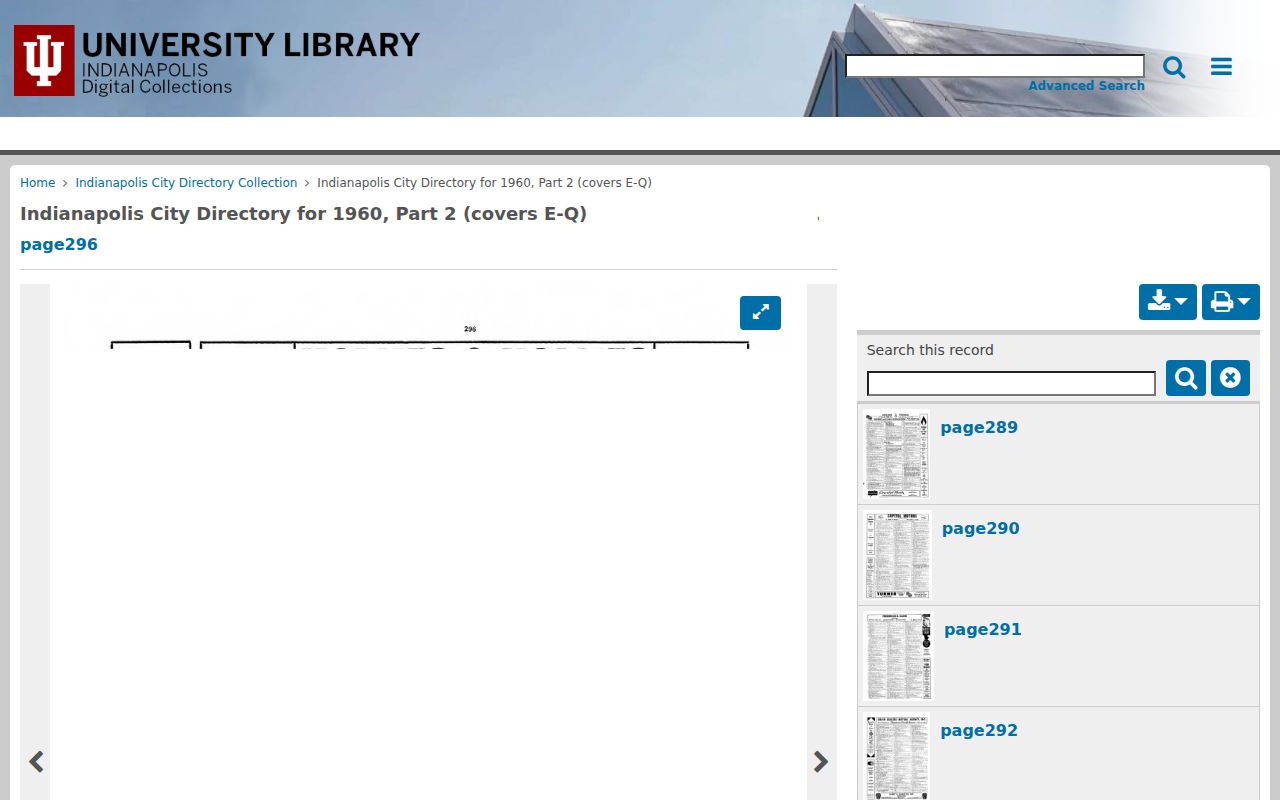
The IUPUI digital city-directory sample shows how compact lines place names beside household, work, and address details.
Access Greenwood Directory Shelves
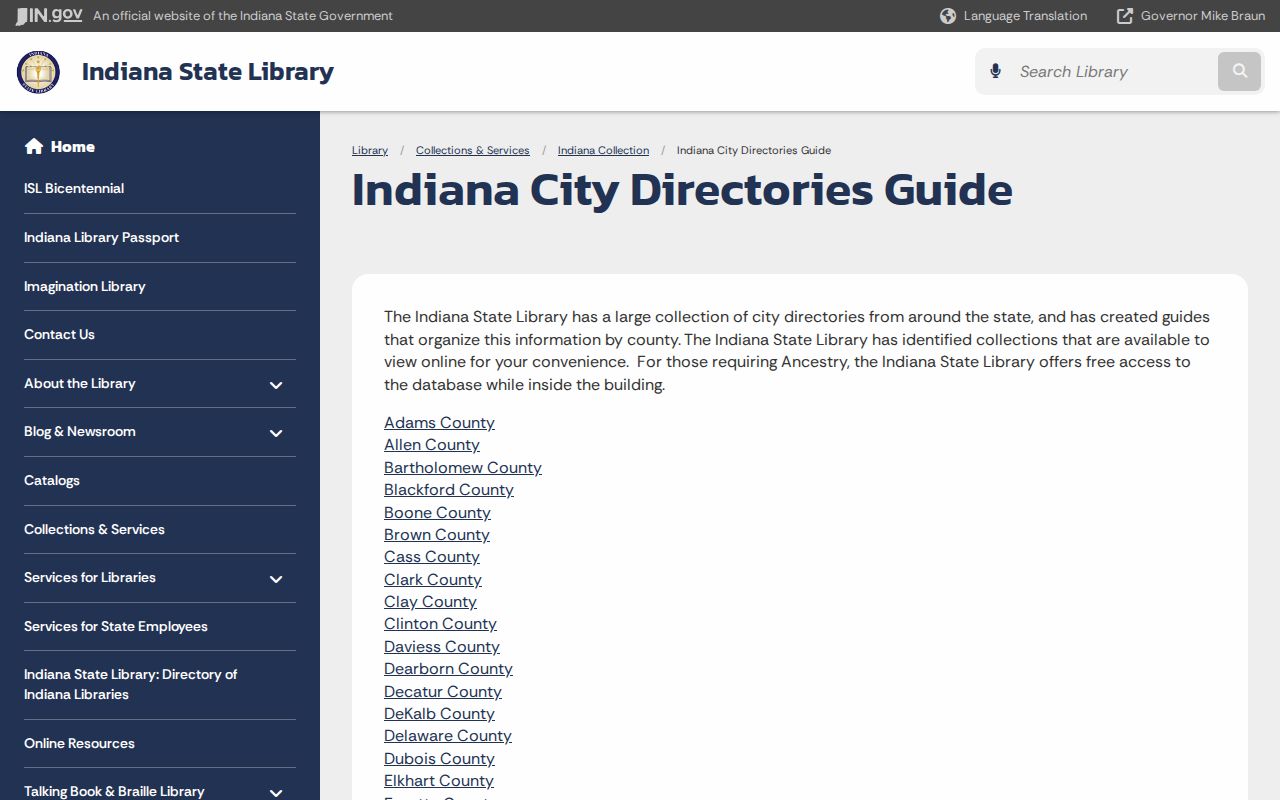
No Greenwood-specific digitized city directory page was found in the official sources reviewed. The reliable route is therefore the State Library's physical or closed-stack holding, using the exact year and call number. The Indiana city directories guide explains the statewide collection and its formats. Contact the library first to ask whether the volume is available, how staff retrieve it, and whether scans, photographs, or copies are permitted.
The statewide guide's access point is shown below.
A catalog entry is not a scanned book. Likewise, a library database listed online may require a library card or use inside the building. Record the access condition with the citation so another researcher knows whether the finding came from an image, an index, staff help, or the physical volume.
Greenwood Library and Museum Clues
Greenwood Public Library digital resources link GHS yearbooks, Memories of Greenwood, Hoosier State Chronicles, Indiana Memory, INSPIRE, and Ancestry Library Edition. The library does not advertise a dedicated public Greenwood city-directory or obituary index. These sources still help test a school, institution, family, or neighborhood connection found in a directory.
The Johnson County Museum genealogy collection adds original documents, school yearbooks, tax indexes for 1843, 1846, 1847, 1848, and 1849, estate inventories, apprenticeship records, and physician-license indexes by name and date. Its research service and programs called “A House is a Home” and “Glorious Graveyards” can open paths that a name-only city directory search misses.
Those museum indexes answer different questions. An estate inventory can point toward a probate file, an apprenticeship entry may connect a young person with a trade or guardian, and a physician-license index supplies a name and date for local professional history. Compare each lead with the directory year instead of treating the museum index as an address record.
The museum began in the courthouse in 1931, moved in 1962, acquired the Masonic Temple in 1988, and transferred its collection there in 1991. That institutional trail explains why a county-history search may pass among the courthouse, museum, State Library, and Greenwood library.
Map Greenwood Directory Addresses
A street-order or criss-cross section helps when an old address is known. Read neighboring house numbers, note vacant or business entries, and photograph the abbreviation key. Then compare the printed address with period maps and present parcel geography. This method does not turn nearby listings into proof of a relationship, but it can show the block as the publisher recorded it.
The State Library's property-research guide recommends pairing city directories with Sanborn maps, plats, county maps, newspapers, and building or real-estate notices. Greenwood Sanborn catalog entries include 1902, 1910, 1920, 1930, and a 1930-1940 entry. City and county map holdings add a 1967 Map of Greenwood and a 1974 City of Greenwood map.
No exact citywide street-renumbering year was located. Annexation, a changed postal city, a renamed road, or a parcel split may cause a false gap. Keep the historical wording and the modern standardized form side by side.
Greenwood Directory Gaps Matter
The documented Greenwood city directory sequence jumps among 1965, 1967, 1971-1972, 1974, and the regional run beginning in 1988. Describe these as inventory gaps, not proof that no directory was published. A search miss can also arise from spelling, editorial limits, a closed stack, a volume that has not been scanned, or a person omitted by the publisher.
Johnson County's 1874 courthouse fire disrupted records and their arrangement. State Library microfilm, later indexes, and independent directories can bridge some loss, but no source restores a perfect continuous roll. Always distinguish the date a record was created from the date it was indexed, filmed, digitized, or retrieved.
Greenwood researchers can also test a directory gap against the State Library's 1967 Map of Greenwood or its 1974 city map. A map may confirm that a street name and place existed in the same period, while county plat material can clarify land context. Neither source supplies an occupant's identity on its own.
Directory evidence also changes meaning over time. The 1895 county volume describes land and post-office context. Mid-century Greenwood volumes use city-directory conventions. Later Haines and telephone books cover a larger region. The publisher's scope belongs in every citation.
Trace Families in Greenwood Directories
Build a family timeline one dated line at a time. A Greenwood city directory may fill years between public census schedules, which the National Archives releases after 72 years. It can also show a move, changed work, a spouse notation, or a new telephone. Each point needs the volume year and page because a directory can be compiled before its cover date.
- Start with the closest documented Greenwood volume and search the full name plus spelling variants.
- Copy the line exactly, including spouse, work, employer, address marks, phone, and abbreviations.
- Move forward and backward through available years, noting every appearance and gap.
- Check the street-order section, a period map, and the nearest released census for the same place.
- Test the timeline with deeds, tax records, newspapers, yearbooks, estate material, and a sourced obituary.
A disappearance has several possible causes: the person moved, died, was omitted, changed names, lived outside the publisher's boundary, or fell into an inventory gap. Search the next source before choosing an explanation. An obituary should be tied to the newspaper and page, while a deed concerns ownership rather than household occupancy.
For present-day parcel and address records, use the Greenwood street directory workflow rather than extending a historical listing into the current day. Keeping the historical shelf separate from modern GIS protects both accuracy and privacy.